

 Electric doors
Cheng 21-A1 Sliding Gate
Typical Application Scenarios
 Request a Quote
WhatsApp
Key Highlights
System positioning: an on-premises smart parking system for one or more lots. It uses a local server, smart terminals, and browser access with no client install.
Local closed loop: license plate recognition, billing, gate control, and data storage run locally, so the lot stays open even if the external network is down.
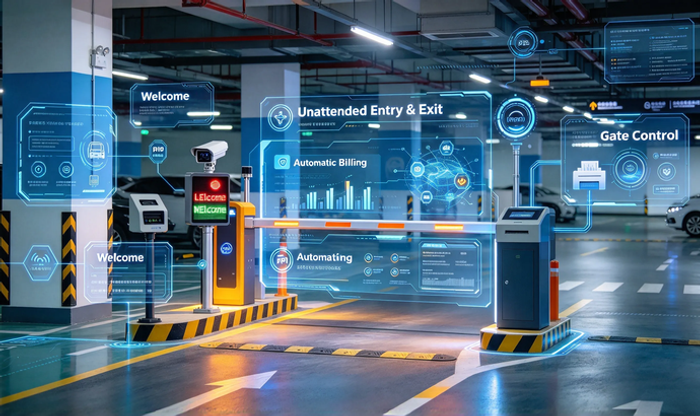
Unattended operation: license plate recognition, voice guidance, on-screen guidance, automatic billing, and automatic gate opening, with remote cloud support.
Globalization: the management interface supports over 30 languages, with multilingual voice and on-screen text, plus configurable currency and location.
Unified multi-device access: cameras, RFID readers, LED displays, barriers, and printers are managed centrally through MQTT and HTTP.
Single-package delivery: front-end resources are built into the back-end service, so one deployment enables browser access and lowers delivery and maintenance costs.
Core Value
An on-premises smart parking management platform designed for standalone sites and multi-location parking portfolios. Deployed on local servers paired with intelligent terminals, it is accessible via any web browser — no client software installation needed.
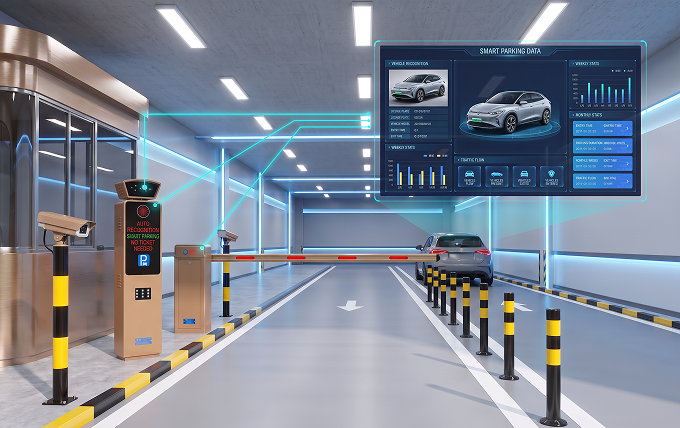
ANPR cameras, RFID readers, LED screens, barrier gate controllers and ticket printers are centrally managed within a single platform, enabling unattended vehicle access, automatic invoicing and barrier control.
All recognition logic, billing calculations, gate decisions and data storage operate locally. This ensures the parking system remains fully functional even during internet outages.
Built for global rollout, the management dashboard supports 30+ languages, alongside multilingual voice prompts and on-screen display text.
Core Modules and Features
Dashboard & Analytics
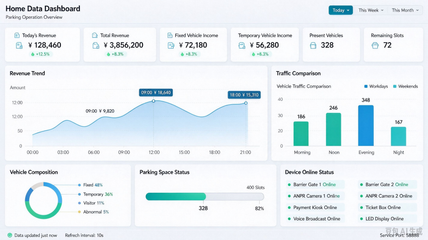
Home dashboard covering today’s and total revenue, fixed-vehicle and temporary-vehicle revenue, vehicles on site and remaining spaces, revenue trends, traffic comparison, vehicle composition and device online status.
Dashboard & Analytics
Home dashboard covering today’s and total revenue, fixed-vehicle and temporary-vehicle revenue, vehicles on site and remaining spaces, revenue trends, traffic comparison, vehicle composition and device online status.
Dashboard & Analytics
Home dashboard covering today’s and total revenue, fixed-vehicle and temporary-vehicle revenue, vehicles on site and remaining spaces, revenue trends, traffic comparison, vehicle composition and device online status.
Dashboard & Analytics
Home dashboard covering today’s and total revenue, fixed-vehicle and temporary-vehicle revenue, vehicles on site and remaining spaces, revenue trends, traffic comparison, vehicle composition and device online status.
System Integration and Architecture
Layered architecture, from bottom to top:
terminal device layer, communication access layer, application service layer, support service layer and data storage layer.
Layered architecture, from bottom to top:
terminal device layer, communication access layer, application service layer, support service layer and data storage layer.
Layered architecture, from bottom to top:
terminal device layer, communication access layer, application service layer, support service layer and data storage layer.
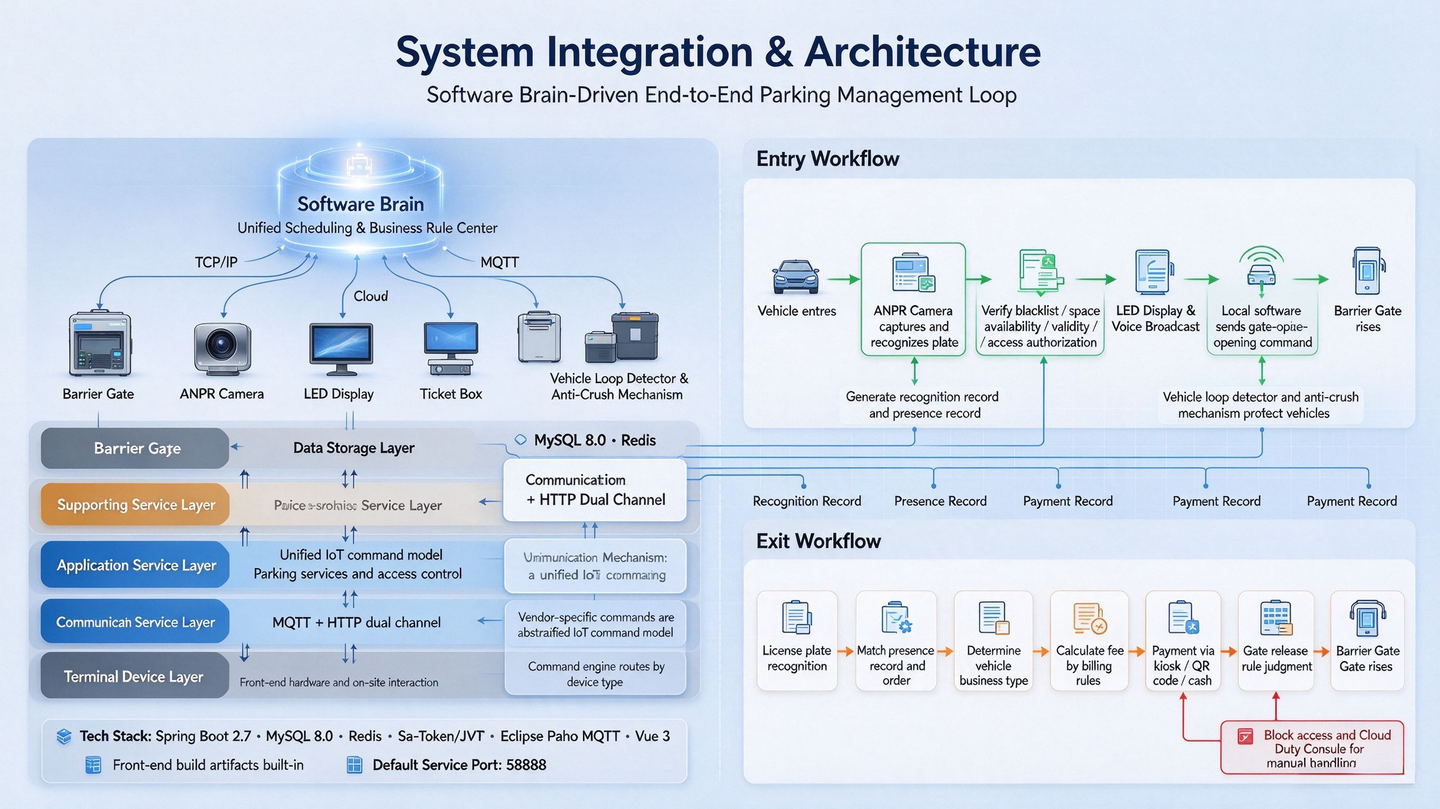
Entry Flow: A vehicle approaches, and the ANPR camera captures and recognizes its plate. The system checks blacklist, lot-full, validity and authorization, then provides LED and voice guidance. The local software sends the gate-open command and the barrier rises. A recognition record and an on-site record are created, while ground loops and anti-smash mechanisms protect the vehicle.
Exit Flow: After plate recognition, the system matches the on-site record and order, determines the vehicle type and calculates the fee according to the billing rules. Payment is made at the payment kiosk, by QR code or in cash. The gate rules are then evaluated and the barrier rises. If evaluation fails, the vehicle is blocked with a spoken reason and routed to the cloud-duty console for manual handling.
Security, Compliance & Deployment
Deployment Options
- On-Premises (implemented): a local server with intelligent terminals, browser access and single-package delivery with a built-in front end; no separate web server is required.
- Supports single lots and lot groups without depending on the external network, with recognition, billing, gate control and storage running as a local closed loop.
Data Security (Implemented)
- Sa-Token login authentication issues a token with a default validity of 24 hours, using header-based authorization and supporting concurrent multi-device login.
- Password policy: new passwords must be at least 12 characters and contain both upper- and lower-case letters and special characters
- Druid’s wall firewall filter is enabled to prevent SQL injection.
- Open device APIs are grouped separately from management APIs, and key operations are recorded in the system log.
Compliance and Items to Confirm
- AES-256 encryption and HTTPS/SSL transport encryption are not mentioned in the manual and must be confirmed against the actual technology.
- PCI-DSS and target-market privacy regulations, such as GDPR, must be confirmed based on the export region and payment methods.
- Encryption and certification standards not stated in the manual must not be advertised as established facts.
Video
Solutions Studies
Related System
START YOUR SMART ACCESS PROJECT
Let's build a better way in.
Tell us about your project. Our international sales team will recommend the right solution.